
Key facts: Water Extraction and Removal
- Removing liquid first shortens the whole drying job.
- Submersible pumps handle deep water, and wands pull it out of carpet.
- Water type decides what stays and what goes.[1]
Which tool does what
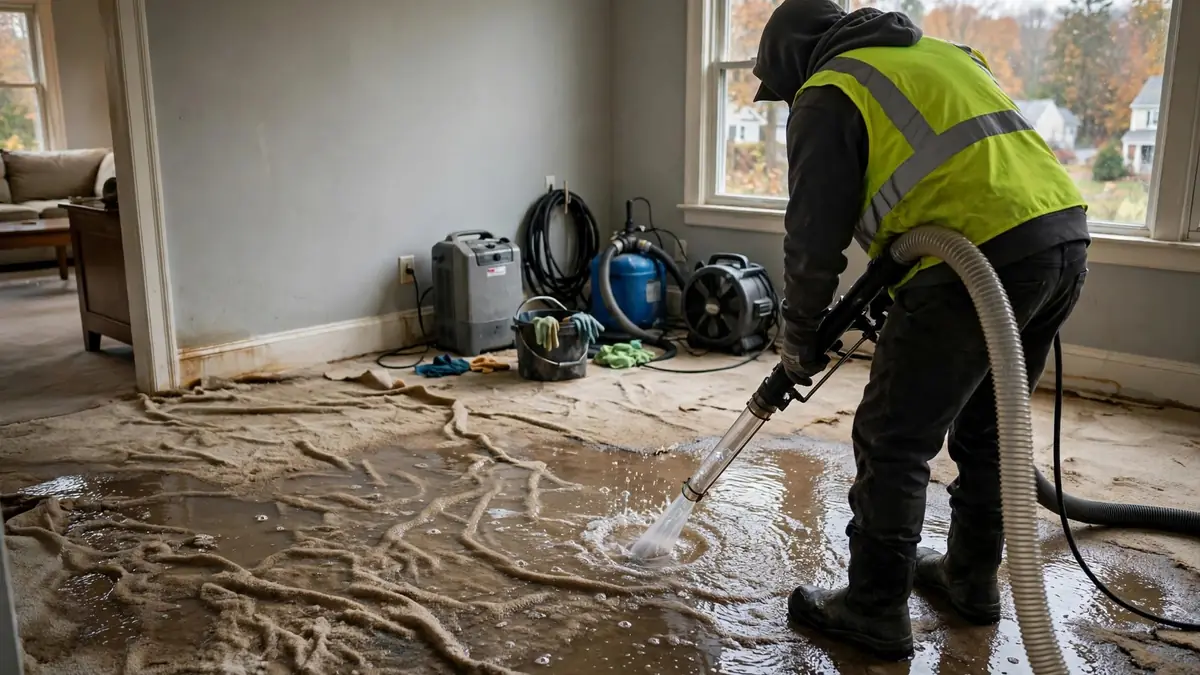
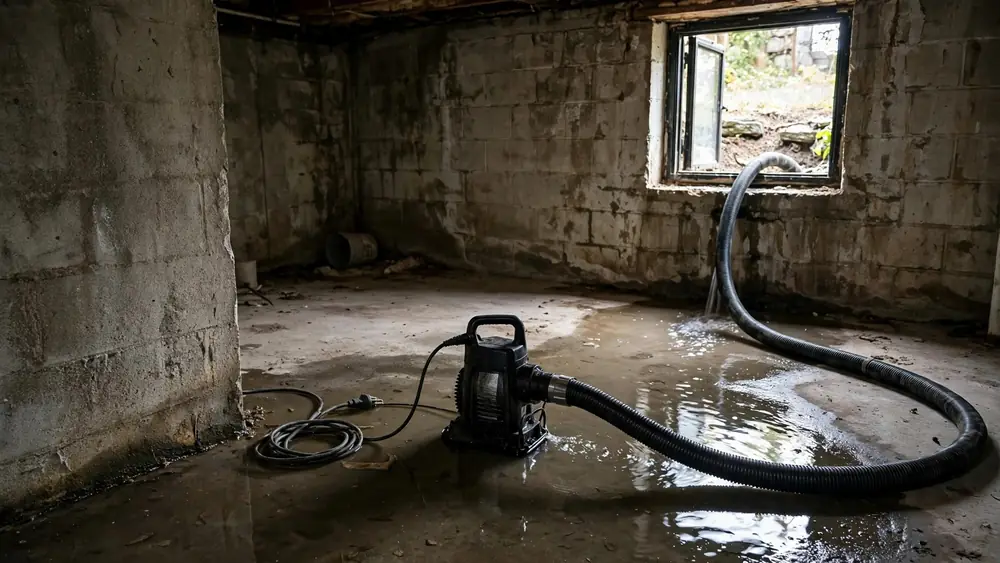
Deep water in a basement goes first to a submersible pump, with a hose run outside. When it is too shallow to pump, wet vacuums or truck-mounted units take over. Weighted or wand tools press water out of carpet and pad. On hard floors, squeegee wands and vacuums finish the surface before drying begins.
A typical extraction visit
- 1
Check safety
Power is checked before equipment enters a wet area.
- 2
Identify the water
Clean, gray or black water sets the approach.
- 3
Pump the deep water
Pumps run until they lose suction.
- 4
Vacuum the rest
Carpets and floors are passed over until little water comes up.
- 5
Take readings
Meters show where hidden water remains.
Water Extraction and Removal in practice
Tell the contractor
- Depth of water, and where it stands
- What kind of flooring is under it
- Whether you can reach the building with hoses
- Whether a floor drain or sump is working
Why a shop vac is rarely enough
A shop vac helps with a small spill, but it cannot press water from carpet pad, and it needs dumping constantly. Standing water in a basement also calls for electrical caution. See basement water damage cleanup for what comes next.
Where the water goes
Clean water can usually run to a floor drain or outside, away from the foundation. Sewage and flood water need more care, and local rules may apply to where they are discharged. Hoses should run so that the water does not simply circle back into the basement, which is a common mistake with garden hoses and small pumps.
How much water is really there?
Standing water is only part of the load. A soaked room also holds water in carpet pad, in the bottom of walls and under flooring. A good crew measures past the wet edge you can see, since water spreads sideways under floors and through the base of walls well beyond the visible puddle.
Questions
Questions about water extraction and removal
Can carpet be saved after extraction?
Clean-water carpet often can, though the pad usually is replaced. Carpet touched by sewage or flood water usually goes.
How long does extraction take?
Small areas may take an hour or two. Fully flooded basements take longer, and the contractor can estimate after hearing the depth and size.
Does extraction replace drying?
No. It removes liquid, and drying then removes what has soaked into materials.
Water Extraction and Removal near you
Pick your area for notes on water extraction and removal there.
- Anaheim
- Atlanta
- Cape Coral
- Cedar Hill
- Clearwater
- Colorado Springs
- Connecticut
- Dallas
- Delaware
- Dickinson
- Ellicott City
- Fort Lauderdale
- Fort Myers Beach
- Fort Myers
- Fort Worth
- Friendswood
- Houston
- Kansas
- Lake Stevens
- Las Vegas
- Louisiana
- Mamaroneck
- Miami
- New Hampshire
- Norcross
- Oregon
- Paterson
- Phoenix
- Port Charlotte
- Prosper
- Punta Gorda
- Riverside
- Salt Lake City
- San Antonio
- San Diego
- Sanibel
- Sarasota
- Seattle
- Venice
- West Palm Beach