
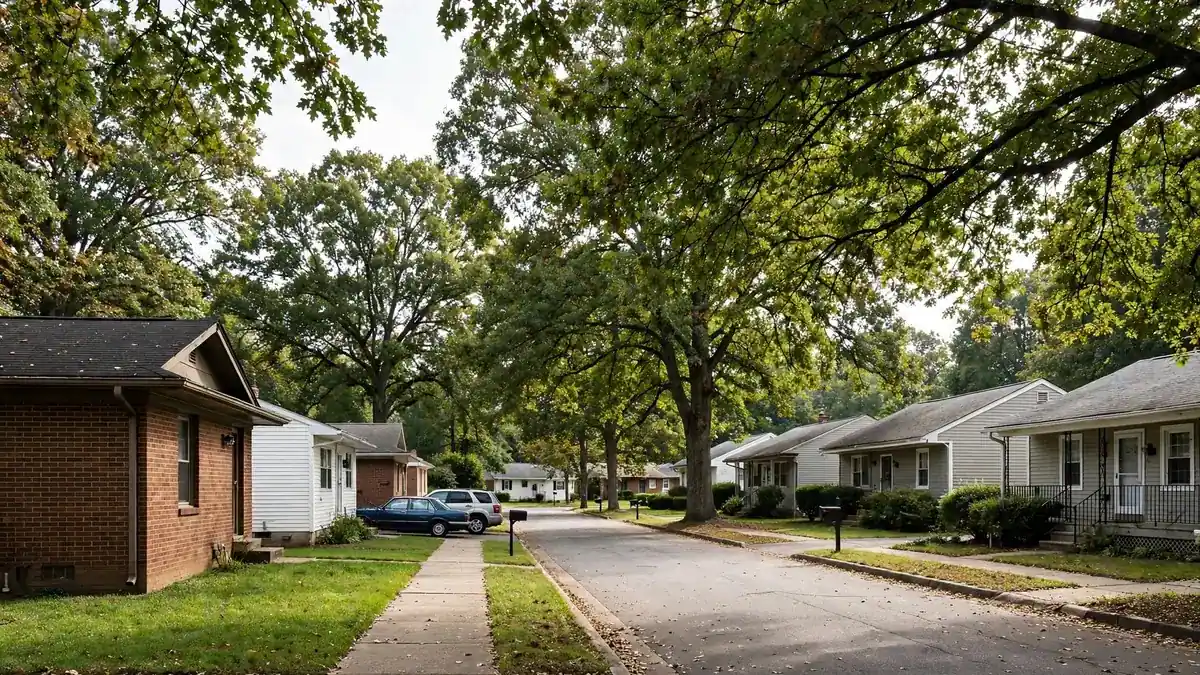
Key facts: Kansas City
- In 1951 the Kansas River topped the levees at Argentine and Armourdale, and homes there went under to their roofs.[1]
- Kansas City, Kansas is split between flat river bottoms and steep bluffs.
- Each brings its own trouble.
Why the basement drain backs up
Combined sewers carry stormwater and wastewater in the same pipe, and heavy rain can overwhelm them.[2] When that happens, the lowest opening in a building may be your floor drain. A backwater valve stops sewage from flowing back through the line, and it is worth asking a plumber about once the cleanup is done.[3]
A closer look in Kansas City
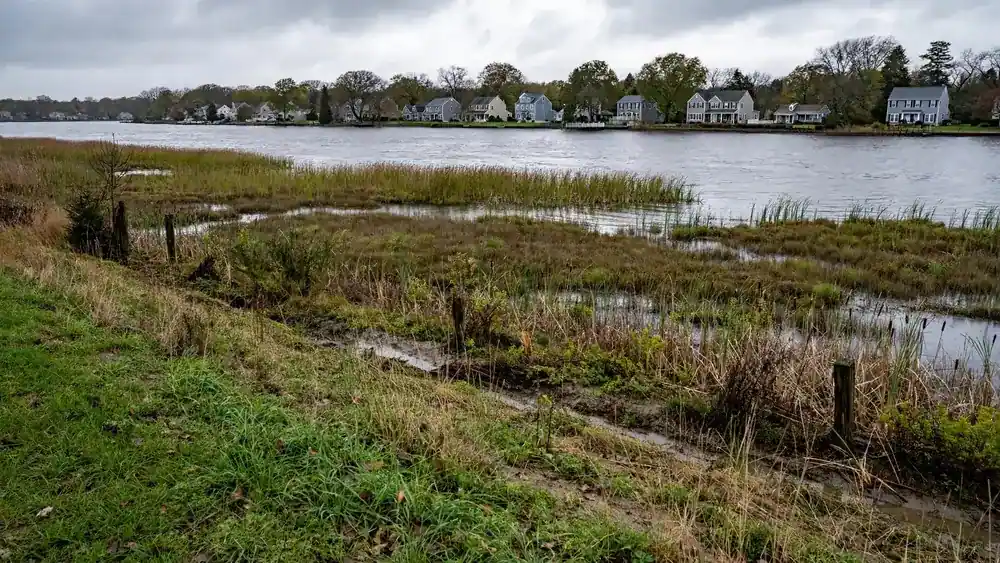
Hillside basements in Rosedale and Strawberry Hill
Houses on the slopes often have a basement wall fully underground on one side and open on the other. Water pressure builds against the buried wall, so expect seepage on that side after long rains, while the open side stays dry.
Flood claims recorded in Wyandotte County
Kansas City sits in Wyandotte County. FEMA publishes every National Flood Insurance Program claim with personal details removed, which gives a plain record of where water has reached insured buildings here.
| Measure | Count |
|---|---|
| Flood insurance claims on record | 434 |
| Year with the most claims | 1998 (74) |
| Largest named event | Midwest Flooding (58) |
| Claims outside high-risk A and V zones | 50% |
| Claims on buildings built before 1975 | 80% |
County-wide counts of insured claims only. Uninsured losses, burst pipes and appliance leaks are not in this data.
What the Kansas City claim record shows
For Kansas City homes, the local precedents are the events behind the most Wyandotte County claims: Midwest Flooding (58 claims), Not A Named Storm (7 claims) and Flooding (6 claims).
About 50% of claims with a recorded zone came from outside the high-risk A and V zones, so a moderate-risk label does not mean a Kansas City home stays dry.
If your Kansas City home is older, note that buildings from before 1975 make up 80% of county claims with a known build date. Many predate current flood maps, so inspect low outlets, ductwork and subfloors closely after any water event.
Federal disaster history for Wyandotte County
FEMA lists 26 federal declarations covering Wyandotte County. The most common types are severe storm (16), flood (5) and biological (2). The latest are Severe Storms, Straight-Line Winds, and Flooding in 2017, Severe Storm, Straight-Line Winds, Tornadoes, and Flooding in 2024 and Severe Storms, Straight-Line Winds, Tornadoes, and Flooding in 2023. When a declaration is open, federal aid may be available to Kansas City residents, so ask about it alongside your insurance claim.
Kansas City weather and your home
Weather records for Kansas City from 2015 through 2024 average 45 inches of precipitation a year, and May and June are the wettest months. The area averages 9.3 days a year with an inch or more.
Kansas City falls to 20°F or below on about 26 nights a year, which puts pipes in exterior walls, crawl spaces and garages at risk.
When rain falls in Kansas City
Seasonal averages for Kansas City, 2015 through 2024. Plan roof, gutter and sump pump checks before the wettest stretch.
| Season | Average | Share of year |
|---|---|---|
| January to March | 6.7 in | 15% |
| April to June | 16.1 in | 36% |
| July to September | 13.4 in | 30% |
| October to December | 8.5 in | 19% |
Modeled from Open-Meteo historical weather data. Precipitation includes rain and melted snow.
Kansas City home checklist from these records
- Don't rely on recent quiet years. Only 8% of Wyandotte County claims date from 2015 or later, so older floods still show what can happen.
- Insulate exposed pipes before 26-plus hard-freeze nights arrive, and know your main shutoff.
- Check roof flashing and drains before May, the wettest month in Kansas City.
- Keep dated photos of each room. After Midwest Flooding, 58 insured Wyandotte County owners filed claims at about the same time.
What to tell the Kansas City contractor
- Your neighborhood
- Whether the water smells of sewage
- Whether it came up through a drain
Services Kansas City callers ask about
Questions
Kansas City water damage questions
Is sewer backup covered by flood insurance?
Often not by default. Many home policies need a specific water backup endorsement, so check your own policy.
Is it safe to clean up a backed-up drain myself?
Black water carries real health risks. Keep people out of the area and call a professional.